Let’s resume our track-by-track deep dive of Hold the Door Open with track 2: “Shine, Child.” (Click on one of the icons below to listen to the song on your platform of choice.)






Quick table of contents:
Seeing our children for who they are
When I was asked to write what became this song back in 2017, I was excited at the prospect–and more than a little nervous. Raising a neurodivergent child has been one of the greatest challenges of our lives, but also one of the greatest joys. When Jess and I were first coming to terms with our son’s likely AuDHD (ADHD + autism) diagnosis, Spencer was barely two years old. We dove into the literature around raising children on the spectrum with a sense of urgency, because (at least in my mind) we had spent critical years of early development working from the wrong books.
The literature we found in 2007 was, well, complicated, and much of it was not exactly encouraging. To be honest, I found there was a regular undertone of self-pity in the parental memoirs about raising autistic children. Most of the authors I read were wrestling with guilt and shame, worried about how to help (or even how to “fix?”) their children. Much of the public understanding around autism and autistic people was still steeped in 20th century notions of “tragedy.” A number of authors leaned into irresponsible, widely debunked nonsense about the “dangers” they had inflicted on their children by having them vaccinated. (Andrew Wakefield lost his medical license for relentlessly publicizing his tainted, biased “studies”, and to me that was never penalty enough for the lasting harm he caused.)
Yes, raising autistic children in a safe and loving way is a tightrope. It requires reserves of strength, hope, insight, and love that will put parents and their relationships to the test. It is often physically, emotionally, and financially exhausting. And nearly twenty years ago, it was not easy to connect with other families navigating that path. We were incredibly fortunate in many ways, including finding a phenomenal preschool program which provided support for all of us. They helped Spencer prepare for school, and I haven’t heard of another program that appears to have done it better.
We were luckiest of all, though, in Spencer himself. His incredible intelligence and his sweet and loving nature asserted themselves from very early on—when we had him assessed, at age two, he had already begun reading and sounding out words in text. I trusted and hoped that his support needs would be moderate (in today’s parlance). His mind was a sponge. He was eager to engage with adults, who could connect with him at a level that peer-aged neurotypical children weren’t able to. And he was endlessly curious and open to learning anything he could about words, numbers, and topics that captured his interest. Spencer, Jess, and I have said repeatedly over the years that given the option to choose anyone for our family, we would be one another’s first choice.
That said, I personally have struggled with the work of letting go of the child I had imagined, to be able to clearly see and embrace the child we were raising. I had more trouble with this than Jess did. It’s a struggle for many parents. The drive to see our children succeed, experience joy, and avoid suffering, is deep and profound in us.
Lived experience, and more acquaintance with autistic adults, have shown me that parents and their emotional needs can become one of the greatest obstacles to the success and independence of neurodivergent young adults. My own ADHD was only diagnosed in my 20s. Once Jess helped me come to terms with the need to get Spencer diagnosed at two, I knew I didn’t want him to go without the proper support a moment longer than necessary. Being a neurodivergent dad to a neurodivergent child of course has its own complications.
I certainly don’t want to pretend our experience with Spencer makes us experts. In the words of Dr. Stephen Shore, who speaks from his own experience: “If you’ve met one person with autism, you’ve met one person with autism.” Different neurodivergent people have very different strengths and needs, and their and their families’ lives are as rich and varied as any other group of people.
All that said, I don’t see our culture express joy, pride, and admiration for our neurodivergent children as much as I would hope. The opportunity to put that experience into words and music was a gift. I hoped then, and still do, that this piece will resonate for neurodivergent people, and their families and friends. In the years to come, I deeply hope it can be a source of joy and comfort.
Songwriting
I wrote about the origins of this song on the song page, but there are some deeper details I’d like to speak to.
Musically, I made a choice that this piece should hold appeal to audiences beyond the SCA. I give the song a touch of SCA grounding with the use of “village” in the first verse, but that’s as far as it goes. With that choice came some freedom in my chord choices.
I have tried more and more to make my songs enjoyable and varied, but also accessible for SCA audiences. If someone wants to learn and perform one of my pieces, that’s the highest honor a songwriter (or bard) could ask for. There are lots of guitar players in the SCA, and if they want to play something of mine, I don’t want the chord choices to be intimidating—and I don’t want to “show off” musically for its own sake. So I tend to keep my chord progressions relatively straightforward, majors and minors and the occasional 7th.
For this song I wanted to let go of those constraints. If I was going to sing about children who are different, and tap into my own profound sense of difference from my own history, I wanted to step outside my safe zone and cut a little looser. More to the point, the chorus starts and ends with the critical word: “Shine.” I wanted this to be a song where the guitar could shine, where the chords would gleam with all sorts of unexpected color. I wanted the sweetness, the joy, and the heartache in the song to show through in the harmonics. So I leaned into variety and color in the chord progressions. Enough so that I added chord charts to my sheet music, just in case anyone might want them.
I may be overstating how wildly adventurous I’m being musically, but again, it was definitely a change of pace for me. Obviously, someone who wishes to play the song can just ignore all the seconds and major 7ths and sus-2s and 4s. But I love the brightness this brings to it.
Lyrically, the song hits me the hardest at the start of the third verse, with “Forging connection was hard for so long / I watched you struggle alone.” I have a specific memory of offering comfort to a preschool child who was, at that moment, inconsolable. That passage in particular makes me vulnerable when performing this piece in a way that I didn’t anticipate.
It turned out that audiences responded to that, something they hadn’t seen from me before. As an audience member, I understand that reaction and do my best to leave myself open to it, without letting it become too rehearsed.
Recording
When I first started preparing the (then-untitled) new album in spring 2018, I had only written five new songs since the release of Hidden Gold three years earlier. “We Are the East” had already been recorded and released as part of the Sing for the East project, though, as I’ll discuss in a later post, I had always intended that song to be on the second album I was planning.
That left me four finished songs to begin recording: “I asked of thee a boon”, “Concordian Soil”, “Plant Your Feet”, and “Shine, Child”. “Boon” was written in the Elizabethan style, and I wasn’t going to subject Dave to recording another lute song for me, despite his excellent work on “Can she excuse my wrongs?” To get started, I worked with Dave on recording acoustic guitar for the other three songs. Those sessions went well, and I was very satisfied with the resulting tracks. I then replaced my initial guide vocals with work-in-progress vocals. I figured I would re-record those later on, but they were more than good enough to use as a base for the other tracks that needed to be added.
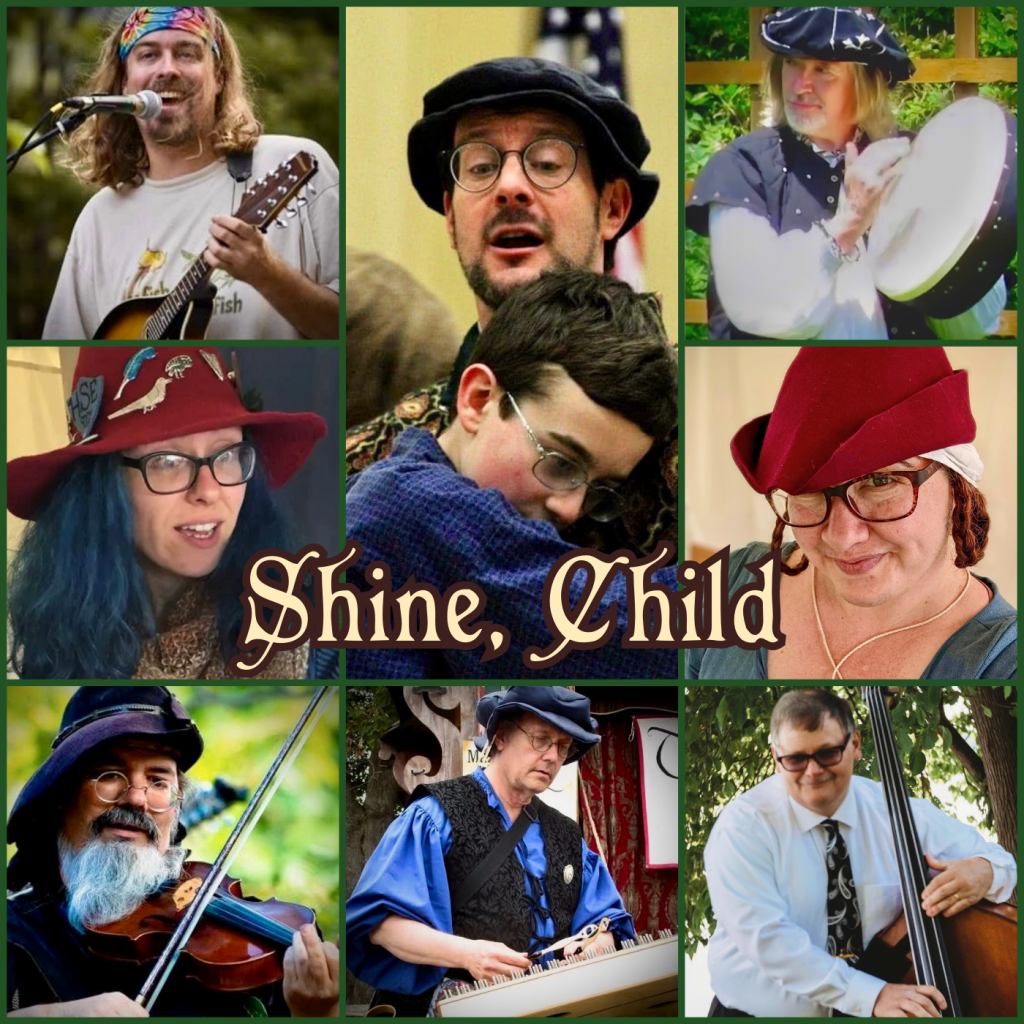
The first of those ended up being Bird the Bard, who visited for a day of recording that summer. They provided beautiful harmonies for the later choruses on this song, as well as some material we’ll talk about later in the series. Their harmony instincts align well with mine, and as someone who identifies on the autism spectrum, I was pleased to have them contribute to this piece.
Between writing more songs, and competing to become royal bard of the East in early 2020, I was busy for the next year and a half. Then Covid hit, and I didn’t resume work on the album until late 2022. Recording picked up in early 2023, and in the next two years I was able to get Cedric Fithelere’s fiddle, Paul Butler’s percussion, and Rich Simon’s cello added to the song during our studio sessions together.
Around that time, I brought in Carson Lutchansky (Silence de Cherbourg to SCA audiences) to collaborate with me on refining the album, enhancing some harmonies, and furnishing guide vocals for female parts. She suggested that a second vocal harmony alongside Bird’s might brighten the choruses on “Shine, Child” a bit more, and recorded a demo. I decided she was right, and added her to the mix.
Throughout the process, I had this notion that a bit of hammered dulcimer would be a great touch for the instrumental break. I spoke with Vince Conaway, the brilliant dulcimer player who is much loved in Renaissance Faires around the country. He has recorded numerous albums of dulcimer music, and plays at Pennsic as Vincenzo da Brescia. (We had managed a fun collaboration at Pennsic in 2019.) Unfortunately, our schedules never managed to align, so I let go of the idea. Paul Butler provided some singing bowl tones to see if that might help, but it wasn’t quite what I was looking for.
It was late 2024 when I finally was able to connect with Chris Mortika for the glockenspiel tracks I had long wanted for “I Must Be Silent” and “Hold the Door Open”. While we were texting about it, I was discussing a component I still needed on one of the songs (I think it was “Homecoming”), and he asked whether I might want to try hammered dulcimer.
“Wait,” I said. “You play hammered dulcimer?” He did. I felt a rush of excitement, and explained about the one place I had been dreaming of adding hammered dulcimer, and that I’d tried and failed to get a track from Vince. “If you’re looking for something in the style of Vincenzo, that I think I can do.” And indeed he did. I finally had all the pieces I needed to put the song together as I had imagined it.
Post production
While I had considered re-recording my vocals for this song, the more I listened to it, the more I realized I had done a really strong take. The only thing I had to punch was a subtle lyric change (“forging connection”, which I decided was stronger than “forging connections”). A pitch tweak here and there, and I was very happy with it. (And if I’m honest, I wasn’t convinced my vocals at age 55 were likely to be stronger than the ones I’d recorded at 49.)
I did spend some time editing the guitar tracks, because I’m a perfectionist, and the high glisten on the fancy chords picked up a few string squeaks. There’s nothing wrong with leaving some natural artifacts of playing an instrument in a recording, but there’s a lot of high end in this, and I really didn’t want it to distract the ear. The overall quality of the guitar work speaks for itself, so it was just a matter of placing it properly in the mix and (if you’ll forgive me using the word one last time) letting it shine.
I really liked Paul’s single percussion line on this song, because it was complex. This was tricky to place properly in the mix. Toward the end, as I went back and researched compression more deeply. I found a way to get just enough pop out of it to support the song without distracting from everything else going on.
Final notes
I made this song Track 2 because it holds a special place in my heart, and I know it has resonated deeply with a lot of audiences. It keeps the energy going in the album from the first song, and it’s just really pretty.
 Drake Oranwood