
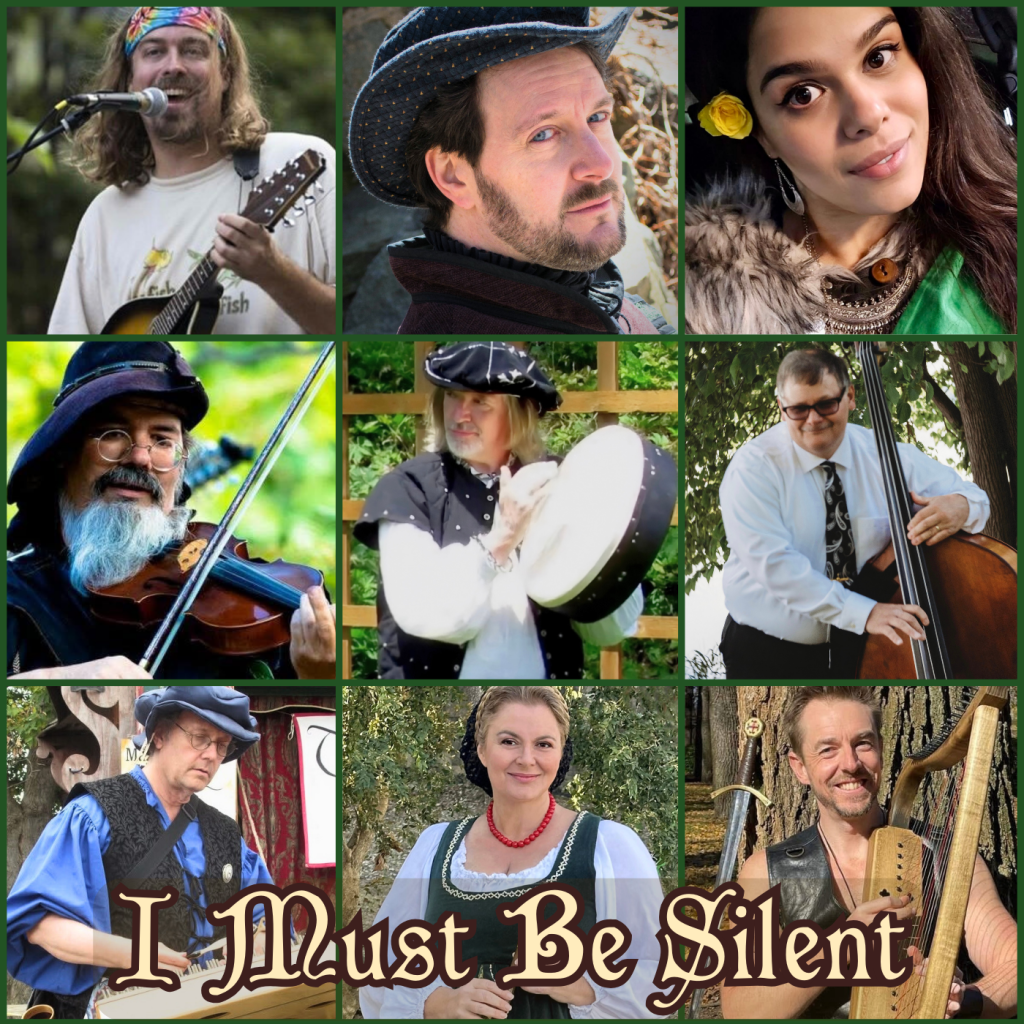
As I posted recently, I’ve made a commitment to reflect and share about each of the 11 tracks on Hold the Door Open as a way of promoting the album a little more, and providing myself with closure on the project. A “deep dive.” So let’s go. Track 1: “I Must Be Silent.” (Click on one of the icons below to listen to the song on your platform of choice.)






Fair warning: this post is a lot longer than I suspect most of the others will be. The first track is one of the most complex on the album, and I’m introducing collaborators, and production notes, that I won’t have to discuss in the same detail in future posts. Here are some topic links in case you want to skip to the parts you find of interest.
- Thomas the Rhymer and me
- The SCA and the language of silence
- Songwriting
- Recording
- Post production
- Final notes
Thomas the Rhymer and me
I came upon Ellen Kushner’s novel Thomas the Rhymer in a bookstore in 1991, about a year after it had been published. I knew the gist of the story because it was briefly discussed in another book (R. A. Macavoy’s Tea with the Black Dragon), so I bought it, intrigued. It instantly became one of my all-time favorite books. A formative part of my relationship with my wife Jessica was reading it to her, front to back. It made such an impression that Jess tracked down a signed first edition hardback copy for me (when I met her in 1999 the book was out of print, a tragedy that has since been remedied). Jessica went on to reach out to Ellen Kushner while we were dating, and over the years that followed we became friends with her and her wife Delia Sherman. (That hardback is now double-signed and personally inscribed to us.)
Why was I so smitten with this book? First, Ellen is simply a spectacular writer. Her gifts for character, voice, setting, and mood captivated me from the first paragraph. Second, I came into the book knowing this was a retelling of an older story (each of the four sections of the book opens with quotations from the medieval romance or the Child ballad in various combinations), and I’ve long been fascinated with art of adaptating and reinterpreting stories across time and different media (which of course would draw me into SCA bardcraft later on).
This was my first real taste of the medieval “fairy tales” of the British Isles, presented with respect and context: Immortal beings of immense power, cunning, and trickery, entangling the lives of mortal men and women, nearly always to their sorrow or at least some regret. In this novel, I would find inspiration for some of my early songs, such as “Changeling” and “Tam Lin of the Elves”.
There are dozens of versions of Thomas the Rhymer out there. Steeleye Span’s song is legendary. What I wanted to bring to my retelling is the key element that Ellen had introduced. In the romance poem, the Child ballad, the Scott version, and all the songs that derive from them, we the audience never actually experience Thomas’s stay in Elfland. We see the journey there, and we see Thomas return. But nothing is said about what he experiences, or how it impacts him, apart from the gift of prophecy or true speech. That of course is transformative, but it still provides no insight about True Thomas’s character. What impact does serving in the elven court have on him? That question is at the center of the novel. I cannot hope to capture the nuance or complexity Ellen’s book achieved, not in a six minute song. But it resonates with me, for reasons I’ll discuss in a moment.
Ellen graciously granted me permission to incorporate elements from her novel into the song I was planning. I’m beyond grateful to her for the opportunity, and I’m hoping that if she hasn’t heard it yet, she’ll give it a listen at some point. When I sang her one of my early songs years ago, Ellen was one of the first people to offer me incisive and generous feedback on what I do well as a songwriter. From the author of my favorite novel and the host of NPR’s long-running Sound and Spirit, that carries tremendous weight. I want to believe this work lives up to the promise she saw in me, and honors the gift she gave so many readers.
The SCA and the language of silence
What’s really fascinating about the True Thomas story is the condition that the elf queen lays on him before they enter her realm. She binds him to silence, and commands him to speak to no one except her. To win his way back home, he must honor that command, and keep his thoughts and his words to himself. He must learn how to be silent, through seven long years of daily practice. In Kushner’s telling, and in mine, Thomas is selected by the queen to be her court minstrel on the strength of his renown as the Rhymer, crafter of words as well as tunes. But while he will be permitted to sing for entertainment, the language he will learn to speak is silence.
Thomas’s time in Elfland occupies a bit less than half of the novel. We get time to know Thomas before his journey: a cocky, charismatic young man whose tongue has a knack for getting him into trouble. And we get to know the Thomas that returns to the mortal world, transformed by years of humbling service with no agency. He is quieter, wiser, but there is an undercurrent of sadness that never leaves him. His life has changed, and he now has a prophetic gift that means he will again be the simple man he was, because of a single choice: kissing an impossibly beautiful stranger without understanding the price.
The first draft of “I Must Be Silent” came to me, title and tune, in a rush of inspiration one afternoon, or at least that’s how I remember it. It was about a month before Pennsic in 2019, and I had been frustrated that I had not written a new song in the past year that I could introduce.
I was also frustrated about my progress as a bard and artist in the SCA, which I had been at for (yes, really) seven years. My Laurel at the time, Zsof, believed I was stalling out. The SCA is heavily gamified, and takes its self-imposed growth path pretty seriously…and I was stuck. Apparently I wasn’t learning the unwritten social rules of the Society quickly enough. For all the time I’d spent internalizing those rules, I seemed to be stuck with a reputation that was not improving.
The rule for feedback in the SCA is: give praise to the gentle. Give criticism to their mentor. Zsof, an out-of-kingdom Laurel, was getting feedback meant for me in big infodumps when she showed up at East Kingdom events a couple times a year. By the time she relayed it to me, it was already out of date, so the people were coming to believe that I didn’t listen to feedback. I do listen to feedback–but I find direct feedback far more helpful than anonymized second-hand feedback. The process had become bruising, and I was starting to spook at my own shadow, convinced that people who were warm and encouraging to my face disliked me behind my back. The joys of being a bard were beginning to fade, and dread was taking its place.
I have ADHD and rejection sensitive dysphoria, and have long thought of myself as an outsider and a social bumbler. I had started to believe that my voice, my belief in myself, and my desire to be seen were preventing me from being accepted in my chosen community. My art or service would only be valued if I learned the language of silence. And while I was learning period music and playing the lute, writing “music of the modern Middle Ages” (SCA folk) is the passion that brought me into this undertaking. It seemed to be drawing constant criticism, suggesting that my creative voice was unwelcome.
I know this wasn’t anyone’s intention…but I’m not the first person to point out these issues. And every so often, when I sing this piece, I’ll see a look or get a comment from someone that tells me they recognize the story behind the story.
It felt as though I was being whispered about by people outside my line of sight, whose names I couldn’t know, and to whom I could not speak. So at that moment, yes, I was very ready to write a song about True Thomas’s seven years of silent service, stripped of agency, and how it changed him.
Postscript: Zsof and I agreed that I needed new mentorship, who could get feedback, advocate, and suggest opportunities for me on a more regular cadence.
Writing “I Must Be Silent” unlocked a new path. When I posted excitedly that I had finally cracked a retelling of Thomas the Rhymer in time for Pennsic, Peregrine the Illuminator immediately offered to provide feedback, given the short timeline I had to ready the song for War. I took him up on it, and the value and clarity he was able to provide cut at least a week out of my editing process for the song. This was a Peer who really got me and my work. Within a couple of weeks, we had reached an agreement with Zsof, that Peregrine and Toki Skaldagorvir (“skald-maker” of blessed memory) would take me on as their joint student. We were able to put out a statement to that effect before I left for Pennsic.
Zsof had been right about what I needed, and I got unstuck. I went on to be chosen as Queen’s Bard, and inducted into the Order of the Maunche, by the end of 2021, with the invaluable help of my new guides.
Of course, I still struggle with these feelings, which were only made worse by the pandemic. (But we’ll pick that up when we get to the last track on the album.)
Songwriting
The song page for “I Must Be Silent” provides documentation behind pretty much every lyric in the song, in obsessive detail. What I didn’t discuss is the musical composition and structure of the song. There’s no time like the present.
When the inspiration came to me and I found a way into this song, I was conscious of not wanting to repeat myself musically. I favor 3/4 and 6/8 time signatures, which work very nicely for that ballad feel, a bit removed from 21st century style. My instinct here was to break from that, and use a meter that imparted a sense of urgency and suspense. It’s ironic, really…I’m telling the story of a man imprisoned in the elfin court, where time loses meaning. But his mortality, his sense of life and missed opportunities in the world he left behind, continues to pulse through him. 2/4, cut time, felt immediately right when I heard it start to take shape. (It also reflected the urgency I felt to be able to complete a new song time for Pennsic, less than a month away.)
The verses push and chafe at their constraints. Two quick lines (“I think back to the Eildon tree / Where strange lady came to me”) followed by a longer line that slows down and breathes for a moment (“There were silver bells hung from her horse’s mane”). We need to cover narrative ground in each verse, so we’ll sing four stanzas of that to give the story the space it needs to unspool, but change the melody on the third stanza, and the fourth serves as a pre-chorus. The refrain continues to move with urgency, both rhythmically and by not repeating chorus. We have a lot of story to tell in five verses; we need to keep the tale moving.
As I practice and performed the piece and then began recording it, I started tweaking parts of the melody. I noticed that I had trouble supporting the sustained interval at the end of the verse, so I added a transitional note to support it. The opening notes of the chorus were originally much higher, and a bit showy. My friend Carson Grey Lutchansky (aka Silence de Cherbourg) helped me tremendously by giving me female guide vocals for all the new recordings on this album that needed them. Singing an octave above me, there were notes that pushed her a little. She’s a terrific singer, and performers can work through these issues…but if Carson and I found parts of the tune difficult, what about other people who might want to learn the song? A good ballad should be comfortable and enjoyable to sing, rather than showing off the vocalist’s pipes.
Another issue came up as I added instruments to the mix. In the third line of the refrain (“Though I harp for the hall…”) the word “harp” was getting lost. The third word of that line is stressed in each refrain and conveys important information: it needs to be heard clearly. Reversing the first three notes, from a downward to an upward run, gave that stressed word the volume and pitch to stand out better in the mix, and sounded just as good musically. Subtle modifications like that shaped and improved the song over the course of the project.
I wrote up notation for some of the instrumental lines, enough to convey specific melodic lines I wanted to use, and to suggest tone and flow for the musicians generally. I realized that I wanted a motif to slot between each refrain and the next verse, and for the intro and the outro of the song. I started with the first few sung notes from the verse and then took it in some playful directions, producing a quick, light riff that maintained the tension. Now we had something to record, and an overall approach.
Recording
My goals for this track were ambitious, because I felt this story merited the best drama, flash, and production values I could bring to it. It has the most elaborate instrumentation on the album, and the biggest role for a guest vocalist. I knew comparisons to “Tam Lin of the Elves” were inevitable: it’s my most popular recording, and they share a lot of plot beats because Tam Lin evolved out of the tale of True Thomas. This piece is one of my favorite originals, as personal as “Tam Lin” was to me. I needed this new recording to measure up, and serve as one of the tentpoles of the album.
Things I knew right away I wanted to incorporate: a female vocalist, harp, glockenspiel, strings, cello, and recorder. I wanted the riff that I’d written to go before each verse to be played on a different instrument each time. I was going to need to assemble a serious roster of musicians for this (all of whom would contribute to other tracks as well).
Quick note: On this blog, I usually refer to Scadians by their persona names, which I consider to be a sign of respect. In the SCA, I prefer Drake, which reflects the time and craft I’ve invested. This “deep dive”, however, is primarily about making a 21st century album. I will refer to my collaborators by the names they use as musicians, which are usually their modern names. There are a couple who perform under assumed names, such as Cedric Fithelere (James Hazlerig) and Bird the Bard (Ariel Contreras, stay tuned for my next post). I’m including the image that I used for the back cover of the CD as each artist is introduced.

Dave Lambert, an old friend, has been my go-to guitarist since I started recording Hidden Gold in 2012. Most tracks on this project started with a guide vocal from me, a strong metronome, and guitar tracks from Dave. Sometimes the those initial guitar tracks were everything we needed. Other times, such as this song, I would bring him back later in the process, when most of the other elements were in the mix, and I knew what needed rework or changes the song needed.
I spoke with a number of singers over the course of recording, but the elf queen was a challenging part to cast (particularly during the pandemic). Thomas’s queen is very different from the fierce and jealous one in Tam Lin that Heather Dale had captured perfectly. This elf queen is courtly, charming, and insightful. Above all, she knows that she is intoxicating and irresistible to Thomas, but she is also deeply fond of him. She is, as she sees it, giving him the gift of her favor as a patron, for a price that seems reasonable from her perspective. Vocally, the part demands a strong, elegant soprano.

It was pretty late in the process that it occurred to me to approach Louisa Valentín, who I had befriended online during the pandemic. She was new to the SCA at that point, though she had been playing with a different medieval reenactment group and had an abiding interest in early music. We hadn’t met in person (she had young children and SCA events were just starting up again), but I knew she lived in New Jersey and was always warm and friendly when we chatted. I listened to some of the recordings of her vocals online. Her formal training as a soprano was very different from the conversational singing style used for the SCA and other modern singing. But (a) her voice was amazing, (b) I suspected she could capture the qualities I was looking for, and (c) those differences, including the traces of her Puerto Rican accent, might evoke a sense of Fae strangeness to the listener. It was definitely worth reaching out to her.
Her response: “I’m your huckleberry.” Gorgeous voice, sense of humor, and excited to be part of the project…we had our elf queen. (We’ll be calling upon her flute skills later in the album.)
Near the end of the project I realized we needed to sing the final like of the song together, in harmony, to close out the piece. Her last vocal adds a nice lift to the ending. join me on the final line of the song.
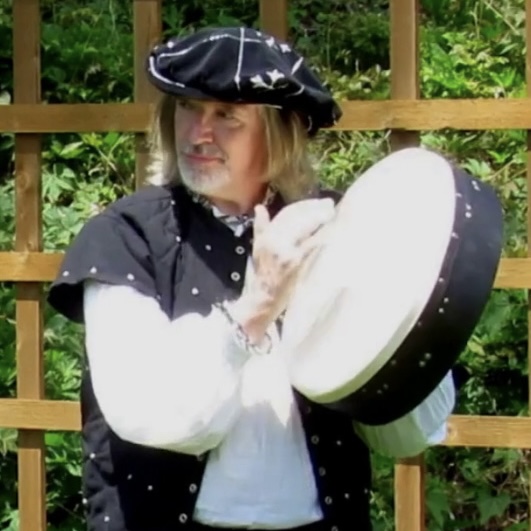
For percussion, I called on Paul Butler (Arden of Icombe), the musical wizard who had done so much work on Hidden Gold. He was now incredibly busy at work, which was part of the reason I was assembling the instrumental team the hard way. But percussion for this album was a project unto itself, in some ways more complicated than most any other instrument, and really needed to happen in my home studio. I had a space with some reasonable sound absorption and a treated ceiling. Without that or a real studio space, drums would pick up reverb and artifacts that would be major problems for mixing.
Paul was able to find enough slack in his schedule for one afternoon of recording, for the entire album. I sent him all the mixes I had, along with sheet music and notes. He showed up prepared, as he always does. We worked quickly, laying down as many textures and rhythms as we could to suit all the tracks that would need them. It was a great foundation–but I was going to need more percussion elements to finish “I Must Be Silent” and the overall album. (We’ll come back to that.)
Strings: Paul was clearly not available for any other instrumental work on this project. What were the odds I’d be able to find someone else who could assemble and then record detailed, complex arrangements virtually on demand, on a schedule that would line up with my needs…for free, in my home studio? Paul and I went back years–we’d met at a performing arts summer camp when we were both teens. That specific combination of talents was not going to fall into my lap a second time. I would need a different approach for this album.
Did I know anyone with deep, deep violin experience and talent? Someone who might be able to collaborate with me in a studio, experiment with different motifs and effects, based on recordings-in-progress and a description of what I needed? Ideally, someone connected to the SCA and/or the filk music community? Someone who might think this sounded like fun, enough to volunteer hours of work? It occurred to me that I knew a guy…

Cedric Fithelere was actually a friend of Jessica’s: fiddler for the Bedlam Bards, former premier bard of Ansteorra, a long-time Pennsic regular. For this project he would be an absolute “get”. I bounced the thought off Jess, who said, “It certainly can’t hurt to ask.” I pinged him on Facebook, much as I would approach Louisa later, and his response was straightforward: “I would be honored to work with a bard of your caliber.” (No, seriously. I blushed to the roots of my hair.)
Jess grinned and gave me her scheming look. “Any chance you’d like a fiddler for your birthday, love? Maybe he’d be up for crashing in our guest room for a week or so…ask if he has any friends in New York he’s been wanting to see? I can find a reasonable round-trip flight from Houston after the holidays.” It sounded great to him, so he visited with us for a week. We spent four days taking advantage of his five-string fiddle, which could be played as a fiddle, violin, or viola as needed.
Cedric was excited to work on “I Must Be Silent”, as a serious fan of Ellen’s novel. I planned out tone and mood as the song built up after the opening verse: verse 2 (meeting the elf queen) needed to be romantic and seductive; verse 3 (the journey to Elfland) needed to be eerie and disorienting; for verse 4 (serving his silent time in the elfin court) I wanted some cinematic, staccato string pops to emphasize the growing tension; verse 5 (the return) needed to be reflective and a bit melancholy, as Thomas takes his leave and contemplates a future with the tongue that cannot lie.
As I’d hoped, Cedric’s depth of experience meant we could try ideas out quickly, and four days to record gave us just enough room to experiment creatively. His work, particularly on this track, is glorious.

Cello: One thing I really wanted to do on this album was get an experienced cello player for the low end. Paul can play almost anything (and did for Hidden Gold), but cello was not a strength, and is very different from playing other bowed strings. We ultimately had used octave violin for those tracks. It served our purpose, but Paul was right that it lacks the smooth richness of an actual cello.
A friend connected me to Rich Simons, a seasoned orchestra player and conductor. Like Cedric, Rich was comfortable with the sort of lines I needed, and we laid down all the cello tracks for the album in one afternoon. On “I Must Be Silent”, he provided the suspenseful plucked line I wanted for the opening verse and chorus, and took the cello across a multi-octave range that gave depth and support to Cedric’s fiddle work.
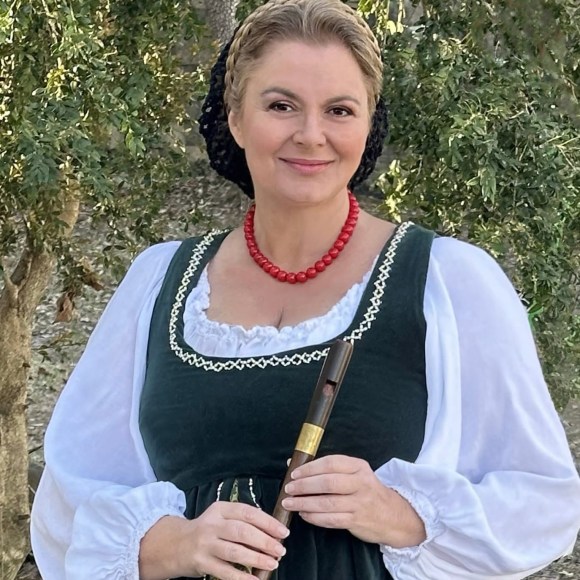
Recorder provides a wonderful tone for this sort of music if woodwinds are called for, and I had in mind a dance between recorder and strings that would create complexity (without being too distracting–but that was a mixing issue).
I knew who I wanted to ask. Sharon Keeling Davis (Elaisse de Garrigues) is a good friend in Missouri who I first met at Known World Cooks and Bards back in 2019 and have hung out with at Pennsic. She was happy to work from my general notions and provide me a few playful tracks to work from, including the sheet music riff.
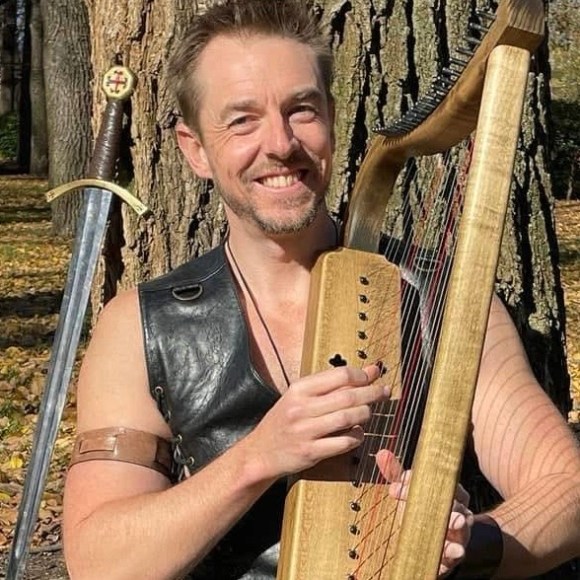
Harp: Sir Walter Scott’s 1803 version of the poem introduces the notion that Thomas played the harp and returned from Elfland with an enchanted one. (I discuss the origin of “harp or carp” in my lyrics notes, but I just learned while writing up this post that Sir Walter was the first writer to actually make Thomas a musician.) This evocative character detail informs later retellings of the story, including Ellen Kushner’s novel and this song version. If I mention he plays harp, we need to hear some harp in the song.
My friend David Yardley (Geoffrey of Exeter), former East Kingdom bardic champion, was kind enough to record the harp parts I had written and send them to me from Australia. (Music from another realm indeed.)

Glockenspiel: When the song mentioned the (fifty and nine) silver bells on the queen’s mount, I immediately began to hear a ringing motif that had to be in the song. I looked up various melodic percussion instruments and determined glockenspiel had the quality I needed.
Chris Mortika, a seasoned musician with experience in the SCA, renaissance faires, and other early music venues, offered his services, working from the lines I’d composed. We collaborated, at his suggestion, using Soundtrap, an online DAW I’d never tried before. I was concerned about possible latency issues, but he got me the tracks I needed without too much fuss.
Post production
I iterate between preparation, recording, editing, mixing, and mastering throughout a music project. With the advent of digital audio workstations (DAWs), it’s easy to do. I generally sit down to do a preliminary edit immediately on getting new tracks to work with. For one thing, the itch to move the needle closer to the finished product I have in my mind is powerful. For another, it’s the fastest way to find out if there are any problems with the recordings. If it’s my singing or playing, I can sometimes go back right away to fix it. If it’s a collaborator, I can reach out to them and ask for some follow-up recording.
This is, for example, how I found out that I had recorded a day and a half of Cedric’s string work with the microphone pointed the wrong way. (Ouch. This is why my mic now has a green and a red dot to make it clear which is the front.) I felt terrible for Cedric, who had had a long week, and neither of us had done a multi-day recording intensive like this. Luckily, the messed up recordings had served as a good practice for Cedric, and we were able to get what I was looking for more quickly the second time around. He saved “I Must Be Silent” for last, because he found it so enjoyable to play, and knew that would give him the adrenaline needed to power through and finish it.
I still needed to figure out what to do about getting a little more variety in the percussion, especially on this song. Paul had recorded a terrific range of tracks, but we’d had to work really quickly to get through everything in one afternoon, with little opportunity for rework or alternate takes. He gave me well over a dozen different tempos, textures, and drum types for “Silent”. But the focus had been straightforward, high-tempo rhythms. For a song with this level of complexity and length, I wanted to have some syncopation in places, and some beats with more space in them for support. I needed maybe 30% more percussion that Paul wasn’t availble to record.
It gave me some real anxiety for a week or two. What was I going to do? The drum loops available in Logic Pro weren’t much help for the sound I was after. And then, it finally occurred to me. I had a whole library’s worth of tracks with the qualities I needed, and they were my intellectual property. Paul’s work on Hidden Gold had produced tremendous variety. Importing individual rhythm tracks from those songs, I had the freedom to carefully repurpose them in places, here and there, as needed. The software could match tempo to the new context, and that works fine for percussion. No one was going to notice that I was reusing some elements unless I pointed it out, and it’s not like it was a problem.
Sure enough, some of the syncopated hand drum work from “Tam Lin” could be used for Verse 2. The rolling natural snare from “The Last Planagenet” could give me some lingering drama, slowed down a bit, for the final verse and chorus. And quickly enough, the rhythm section filled out the way I wanted it to.
The mix for this one, as you can imagine, was complicated. One tool that made the process a lot easier was the LEVELS plugin I bought from Mastering the Mix. Some of their products may not have been as useful to me as I might have liked, but this one made a difference. It allowed me to track several track metrics at once, and would pop redlines if any went out of the defined range. It helped me start getting more of a feel for key elements of a good mix and master, including loudness (distinct from volume), dynamic range, stereo balance, and leaving bass room for drums and bass (or cello in my case).
I went much deeper into research on EQ and other techniques than I’d done before. I was going to have to go beyond the out-of-the-box presets to blend Louisa’s powerful vocals properly, along with other high frequency elements like the fiddle’s top range, the recorder, and the glockenspiel. While Louisa and I recorded in the same space and with the same hardware, male and female vocals need different elements brought up and smoothed down to sit well together.
Similarly, I had to figure out how to manage the pulse from Paul’s drums without the bottom and mid frequencies getting boomy or muddy. I needed to be aggressive in places, and then solicited feedback from experienced listeners.
To separate Cedric’s fiddle from Sharon’s recorder when they were playing in the same high-frequency band, I learned how to use dynamic EQ side-chaining, which would suppress just the conflicting frequencies on one track, and only when those frequencies were actually playing at high enough volume to cause interference. TDR Nova, a plugin from Tokyo Dawn Records, provides this capability, and can be used free or paid to get the full range of channels. It was worth the money.
It was very close to the end of the project when I finally got a better understanding of how to use compression properly, and apply it to individual components and the song overall. I owe that largely to Neil Fein, my mastering engineer from Hidden Gold. That was the piece I’d been missing for so long that made me feel like I had to drop the drums too low in the mix. I was able to take out a lot of multipressors that were doing too much and not enough.
Judicious compression, playing through different presets and tweaking, finally gave each element the right amount of pop and prominence so that nothing got buried and the listener could pick it out if they wanted to focus their ears for it. It’s a hallmark of the mixes I was trying to emulate. Which is why it mattered that I spent more time checking what I was doing against reference tracks in the same genre.
Sibilants continue to be the bane of my existence. I’m sure a big piece of this might have been solved by investing in a higher end microphone, but I made my choices and had to live with them. Even with the best microphone in the world, applying proper de-essing is still essential. I made the choice to use an exciter to add air and sparkle to the master, which meant I needed to make sure I had tamped down the high frequencies enough to prevent them from hissing and cracking in the final output. I found a lifesaving YouTube video showing me how to get really detailed but natural sounding de-esser using a cloned version of the vocal track, offset by a few milliseconds and sent to a bus. TDR Nova came in handy again to provide side chained dynamic EQ to push the sibilants down to an appropriate level without sacrificing clarity.
In a few cases, I needed to boost some of the sibilants, because I spent a lot of time on these lyrics and wanted them to be clear and comprehensible at all times. When in doubt, I pushed clarity at the risk of a trace of top end hiss. I’m sure a veteran mastering engineer would have worked out how to achieve all of it, but I made my choices and stand by them.
As I got feedback for the final master, Paul had a great suggestion. He noted that for whatever reason, the bottom end on this song was coming through a little light compared to the other tracks. He suggested I clone my cello line and add a doubled track of it, dropped an octave using a modulator. Bringing that in at about a third the volume, offsetting it a touch to prevent phase distortions, I heard the difference. I also found, listening to my reference tracks, that applying some stereo spread to the lower frequencies gave me a nice rich extra fatness to support the song.
Finally, I needed my master loud enough to stand alongside the reference tracks. I ultimately decided to use normalization to get the masters across the album to a shared level. More seasoned engineers may say that’s not the way to do it, and I hear them, but it worked better for me than anything else I’d tried. I didn’t do it blindly, and made adjustments where I needed to.
Final notes
I did say “deep dive,” didn’t I?
Why did I make this the opening track for the album? I think the hard work paid off. It’s a showpiece that I hope draws listeners in and makes them want more, promising high production values for the album as a whole. And it’s just one of my damn favorites. I still love listening to it, and I hope you do too.
We’ll pick up with track 2, “Shine, Child” next time.
 Drake Oranwood